
10 October 2026 → Mexico – Baja California Sur and making landfall on the Mexican mainland
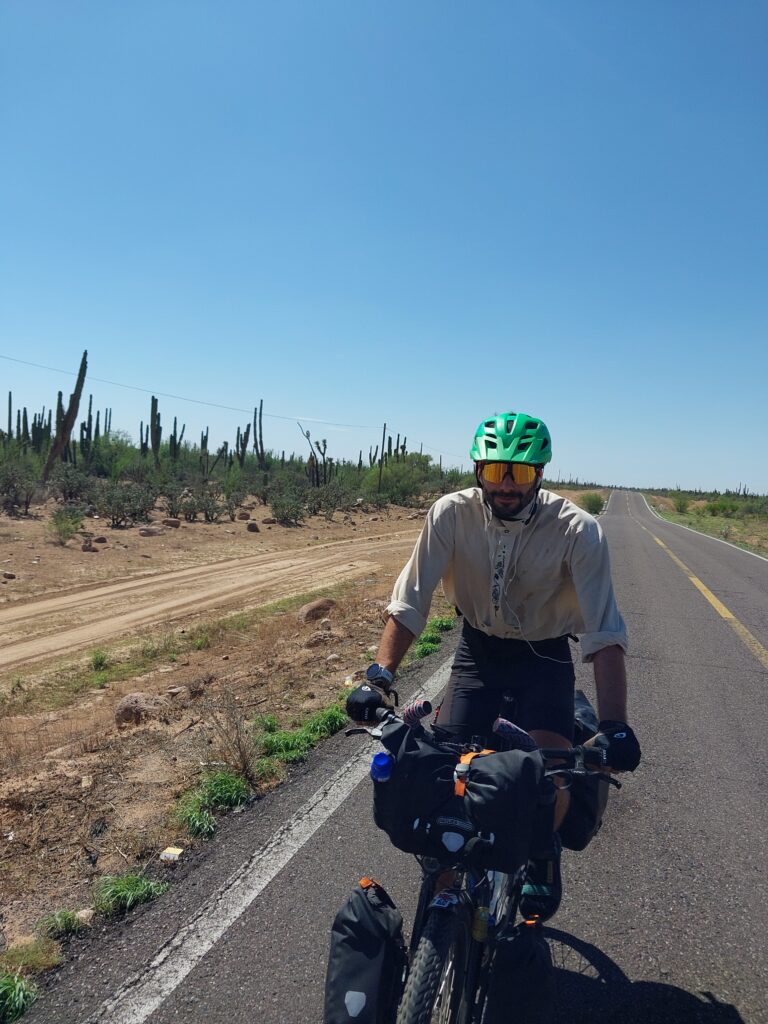
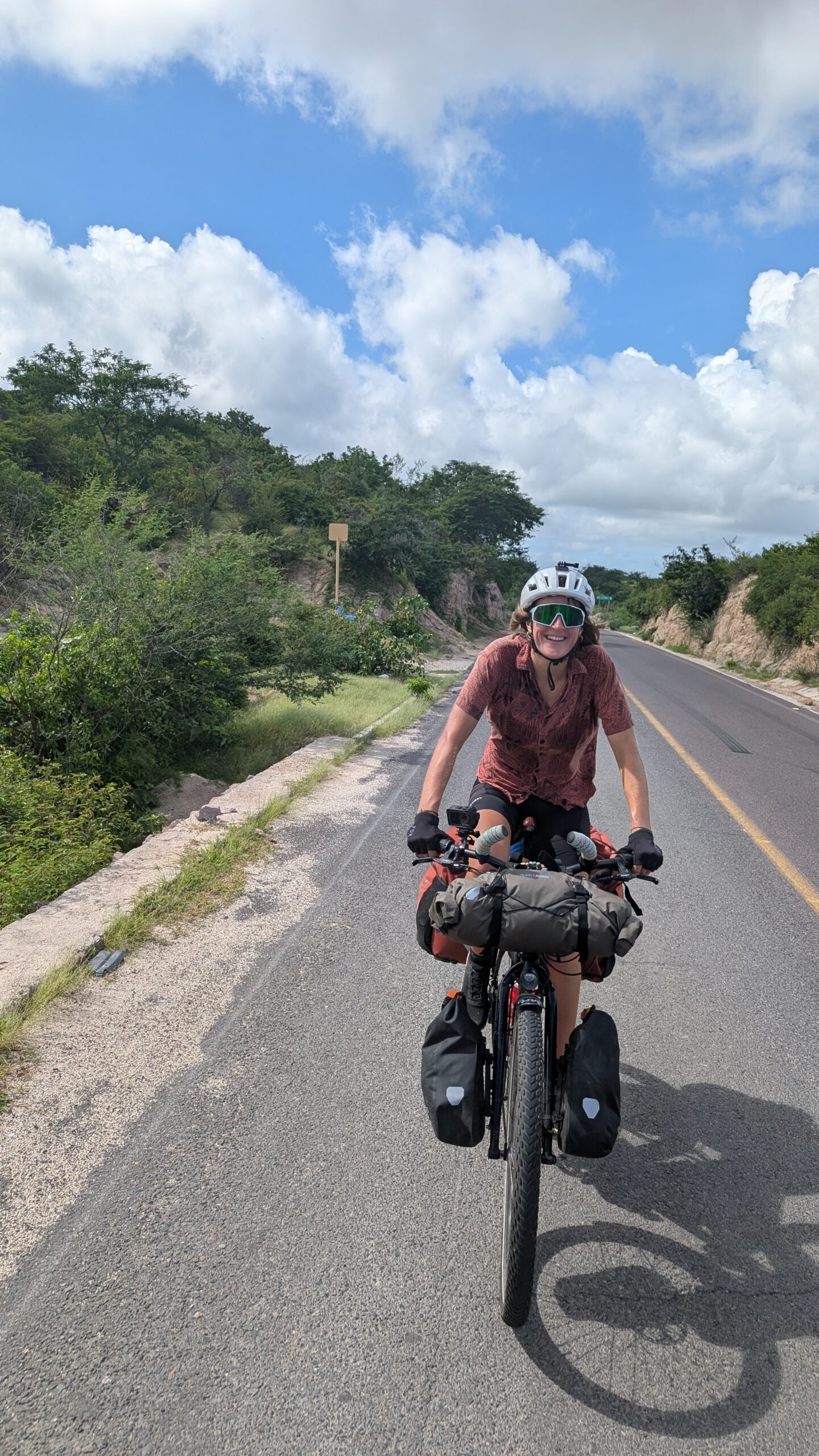
There is something inherently acrobatic about crossing a continent by bicycle. When you think about it, we are travelling on a strip of rubber barely three centimetres wide, kept upright simply by our willingness to keep moving forward. Gripping our handlebars like an acrobat holding onto his balancing pole, we are constantly fighting against the fall. It goes without saying that a stone, a pothole, or a sudden and violent gust of wind can send us tumbling to the ground. Concentrated on maintaining this continuous line, with both eyes fixed on the road, we nevertheless sometimes lift our heads and contemplate the landscape: worlds changing with every latitude we cross.
As you may know, it is often difficult to perceive the effects of climate change in the short term. We often ask older generations what things were like when they were young. Were there heatwaves in summer? How many days of snow were there in winter? Their answers are inevitably based on memories and feelings, which can sometimes be misleading — the human memory being what it is. As a scientist, however, you could look at the evolution of average temperatures over the past decades and observe that France has warmed by around 2°C since 1990 [1]. It is difficult to grasp the significance of such a seemingly small variation, even though all of us, or people close to us, are already experiencing its consequences. So how can we truly become aware of and feel the consequences of this transformation, and turn that awareness into a determination to fight for a better world?
I would like to suggest another way of looking at it, based on our own journey.
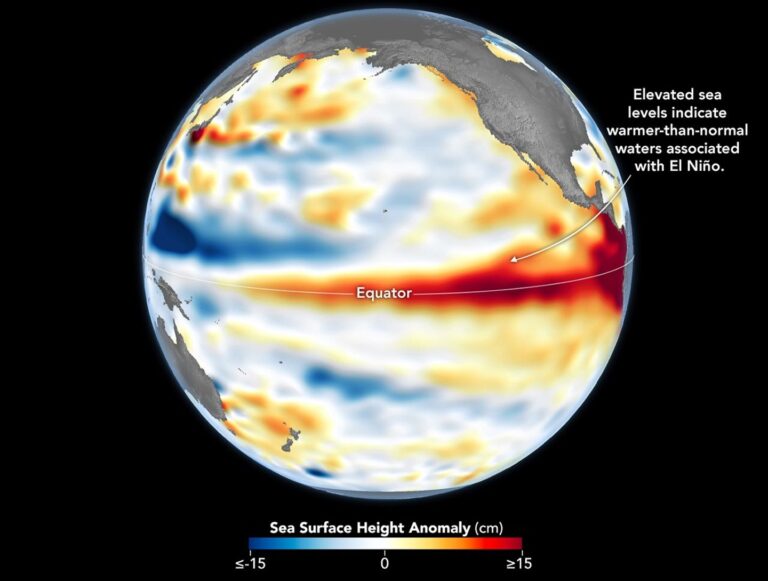
In a particularly striking way, this journey has made us experience a major short-term climate anomaly specific to the Pacific region. On 11 June 2026, the National Oceanic and Atmospheric Administration (NOAA) announced the onset of an extreme El Niño event in the Pacific Ocean.
But what exactly is El Niño?
It is one of the largest natural perturbations affecting the Earth’s climate system — quite a statement. It is important to emphasise that El Niño is a natural phenomenon, independent of anthropogenic global warming caused by greenhouse-gas emissions. However, it is occurring against the backdrop of an already destabilised climate system, and the two phenomena inevitably overlap, potentially amplifying certain extreme events such as floods, droughts and tropical cyclones. One of the main mechanisms behind El Niño is the abnormal warming of surface waters in the Pacific, which alters atmospheric circulation and regional climate patterns, including the Walker circulation [2][5].
Returning to our bicycle journey, our reality has intersected with the reality of the people who live here, and we have seen and felt some of these effects first-hand.
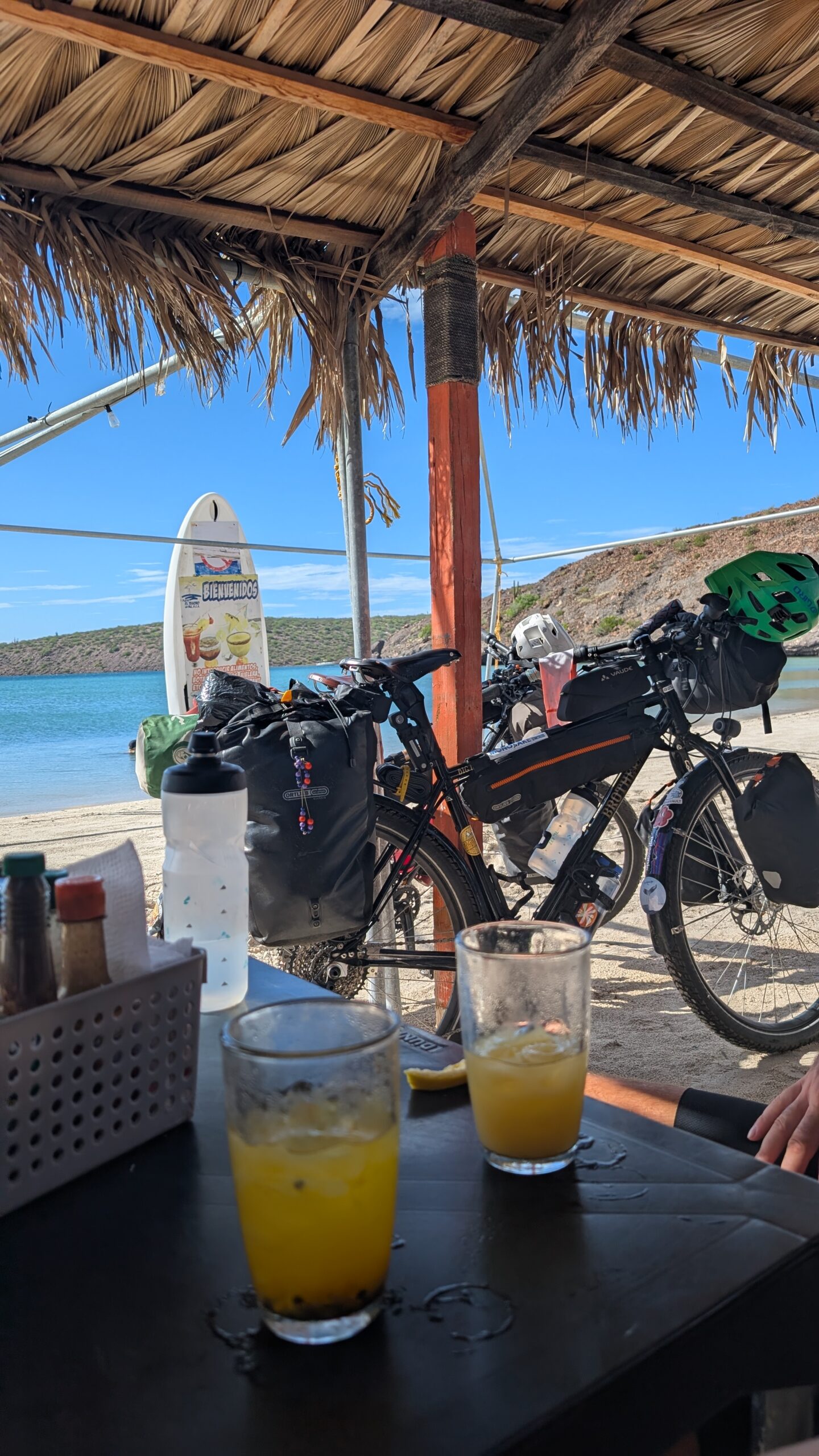
One of the most striking consequences associated with El Niño is the temporary rise in sea level [3]. The beautiful beaches of the Sea of Cortez, extensively developed for tourism, were partly underwater. In many places, reaching the shore meant simply walking through the water. From our bicycle saddles, we observed recently deserted holiday complexes standing barely ten centimetres above — and in some places seemingly below — the water level.
Consider Ensenada, the Mexican port city south of San Diego, usually known for its relatively pleasant temperatures thanks to the cooling influence of the Pacific Ocean. During our passage, however, the heat was described by local residents as unbearable and unprecedented for the month of September. Our host, Xavier, who has lived there for several years, was genuinely concerned.
In La Paz, we experienced the preparations for Hurricane Polo, which led to the closure of all schools and public facilities for almost a week. The hurricane caused five deaths and significant damage to road infrastructure, including sections of the Baja California road that we had travelled only a few days earlier. For our part, we shared the home of a Franco-Mexican family who offered us refuge during the storm. We had to stock up on food and water in case of a power outage: without electricity, there is no pump to provide water for showers, toilets or drinking. A second hurricane, Rachel, following in Polo’s wake, forced us to postpone our crossing to the mainland by boat. And now a third storm, named Simon, is heading directly towards us and is forecast to reach Category 4 strength as it passes near Sayulita, the village that should have been our rest location.
The multiplication of tropical storms over such a short period — barely two weeks — is highly unusual for the region and illustrates, for us, the potentially devastating interaction between natural climate variability and a warming climate. This additional layer of climatic uncertainty has become, in my eyes, another form of insecurity — added to the physical difficulty of the journey and the challenges already present in the region. When I left home, I had never imagined that I would have to monitor hurricane tracking maps every single day in order to decide which route we could safely take. As I write these final lines, we have left the coast and taken transport towards the mountains, to the city of Tepic. It was the right decision: some coastal villages had already reportedly been evacuated the previous evening as a precaution.
In a way, El Niño offers us a glimpse of a possible future — of what could become increasingly normal within 30 years…
I can easily imagine large portions of the route we have travelled being partially abandoned within a few decades, deemed increasingly difficult or even impossible to inhabit because of climatic conditions. To witness such a possibility within my own lifetime feels surreal. Yet climate models increasingly take into account the possibility of tipping points and self-reinforcing feedbacks within the Earth system [4]. These mechanisms do not mean that an inevitable, runaway climate catastrophe is upon us. But they do tell us that the climate system contains thresholds beyond which some changes could become extremely difficult, or impossible, to reverse on human timescales.
I will return to Europe carrying this experience with me — in my luggage, and in my own flesh — together with a renewed determination to find that fine line on which we can balance, and to awaken consciences before we lose it.
A small note
I invite you to learn more about the Südwind donation campaign through our Pacific Voices project. Your contribution goes directly to a human-rights organisation supporting European projects focused on climate justice and the protection of planetary ecosystems.
Südwind donation link:
https://www.suedwind.at/pacific-voices/
Sources and references
- Walker circulation:
https://en.wikipedia.org/wiki/Walker_circulation - Evolution of France’s annual average temperature since 1990:
https://www.statistiques.developpement-durable.gouv.fr/edition-numerique/chiffres-cles-du-climat/fr/3-observations-du-changement-climatique-et - El Niño and sea-level changes:
https://science.nasa.gov/earth/earth-observatory/el-nino-is-underway/ - Climate tipping points and abrupt changes: IPCC, AR6 Synthesis Report, p. 84:
https://www.ipcc.ch/report/ar6/syr/downloads/report/IPCC_AR6_SYR_LongerReport.pdf - El Niño–Southern Oscillation:
https://en.wikipedia.org/wiki/El_Ni%C3%B1o%E2%80%93Southern_Oscillation

FR – Une leçon d’équilibrisme
10-Oct-2026 -> Mexico – Baja California Sur et Accostage sur le continent de Mexico
Il y a bien quelque chose qui tient de l’équilibrisme que de traverser un continent à vélo. Quand on y pense, nous roulons sur une bande de 3 cm d’épaisseur qui ne tient que par le fait que l’on ait le courage d’aller de l’avant. Serrant nos guidons comme l’acrobate son balancier, nous luttons contre la chute à tout instant, car il va sans dire qu’une pierre, un trou ou une rafale de vent trop violente et nous voilà par terre. Concentrés à maintenir cette ligne continue, soit les deux yeux rivés sur la route, il nous arrive de lever la tête et de contempler le paysage, ces mondes changeant avec les latitudes.
Vous le savez peut-être, il est souvent difficile de voir les effets climatiques à court terme. Souvent, on demande aux plus anciens comment c’était quand ils étaient jeunes ? Y avait-il des vagues de chaleur en été et combien de jours de neige en hiver ? La réponse est toujours basée sur des souvenirs et des sentiments qui peuvent parfois être trompeurs, de mémoire d’Hommes… Puis, en scientifique, vous pourriez regarder les évolutions de températures moyennes sur les 15 dernières années, voyant qu’en France la température annuelle est de +2 degrés Celsius depuis 1990 [1]. On a du mal à concevoir cette petite variation, même si on en souffre tous, ou nos proches. Comment prendre conscience et ressentir les conséquences de ce changement afin de le sublimer en lutte pour un monde meilleur ?
Je vous propose alors un autre angle d’approche, basé sur notre aventure…
D’une manière particulièrement surprenante, ce voyage nous fait vivre une anomalie climatique majeure et de court terme, propre à la région du Pacifique Ouest. Le 11 juin 2026, le National Oceanic and Atmospheric Administration (NOAA) annonce qu’un El Niño (extrême) est déclaré dans l’océan Pacifique.
Mais c’est quoi El Niño ? Ce phénomène est LA plus grande perturbation modifiant le système climatique terrien, rien que ça. Il faut le dire, c’est une perturbation naturelle indépendante du réchauffement climatique (= émissions de gaz à effet de serre entraînant un réchauffement global). Il intervient dans un contexte de crise climatique et il y a évidemment une superposition de ces deux entités, soit plus d’événements extrêmes (inondations, sécheresses, ouragans, …). La cause principale d’El Niño est le réchauffement des eaux de surface du Pacifique, modifiant les systèmes climatiques de la région (cellules de Walker – [2]+[5]).
Revenant à notre cyclo-voyage, notre réalité croisant la réalité des personnes qui vivent « Ici », nous avons vu et ressenti sur notre passage ses effets. Le plus spécifique à El Niño est l’élévation du niveau de la mer [3]. Les belles plages de la mer de Cortez aménagées pour les touristes étaient sous l’eau, souvent, pour y accéder, il fallait passer les pieds dans l’eau. Nous avons observé depuis nos selles des complexes de vacances fraîchement désertés lors de notre passage, à 10 cm sous le niveau de la mer.
Si nous prenons à témoin Ensenada, ville portuaire mexicaine au sud de San Diego, habituellement agréable dû à la fraîcheur de l’océan Pacifique. Les chaleurs lors de notre passage étaient décrites par les locaux comme insoutenables et du jamais vu pour le mois de septembre. Notre hôte Xavier, qui y habite depuis plusieurs années, se faisait du souci.
À La Paz, nous avons expérimenté la préparation à l’ouragan Polo, fermant la totalité des écoles et lieux publics pour presque une semaine. Cet ouragan a fait 5 morts et de gros dégâts aux infrastructures routières, notamment à la route de Basse Californie que nous avons empruntée quelques jours plus tôt. Pour notre part, nous avons partagé le lieu de vie d’une famille franco-mexicaine. Cette jeune famille nous a offert refuge lors du passage de l’ouragan. Nous avons dû faire des réserves de nourriture et d’eau en cas de coupure de courant (pas d’électricité, pas de pompe pour l’eau de la douche, des toilettes ou pour boire). Un deuxième ouragan, Rachel, dans le sillage de Polo, nous a fait reporter notre traversée vers le continent en bateau.
Un troisième, du nom de Simon, fonce actuellement droit sur nous, supposé de catégorie 4 lors de son passage sur Sayulita, notre village hôte. Cette multiplication de ces tempêtes tropicales, sur deux semaines de temps, est absolument anormale pour la région, confirmant l’effet dévastateur de la superposition d’El Niño et du réchauffement climatique. Cette couche d’imprévu de catastrophes climatiques est pour moi un facteur qui s’ajoute à l’insécurité de la région et à la difficulté physique du voyage. Je n’avais pas imaginé en partant de la maison que je devrais monitorer les radars cycloniques tous les jours afin de définir notre trajet. Au moment où j’écris ces dernières lignes, nous avons fui la côte et pris un transport pour rejoindre les montagnes dans la ville de Tepic. C’était une bonne décision, car certains villages de la côte ont déjà dû être évacués hier dans la soirée par mesure de sécurité.
D’une certaine manière, El Niño est un avant-goût de la normalité qui sera la nôtre dans 50 ou peut-être 30 ans. Je pourrais bien m’imaginer que de larges portions de notre route soient d’ici quelques décennies désertées, considérées comme climatiquement inhabitables ! Voir cela de mon vivant me paraît surréaliste, mais les modèles climatiques considérant des phénomènes d’emballement [4] donnent raison à cet entendement. Je vais rentrer en Europe avec cette expérience dans mes valises (et ma chair) et cette volonté de trouver cette ligne fine sur laquelle me balancer afin de réveiller les consciences !
Petite note : Je vous invite à vous renseigner sur la page de donation Südwind à travers notre projet Pacific Voices. Votre argent va directement à une organisation des droits de l’homme pour des projets européens sur la justice climatique et la défense des écosystèmes planétaires.
Lien donation Südwind : https://www.suedwind.at/pacific-voices/
Sources et références :
1. Cellules de Walker : https://en.wikipedia.org/wiki/Walker_circulation
2. Évolution Température Moyenne annuelle France depuis 1990 : https://www.statistiques.developpement-durable.gouv.fr/edition-numerique/chiffres-cles-du-climat/fr/3-observations-du-changement-climatique-et
3. El Niño niveau de la mer : https://science.nasa.gov/earth/earth-observatory/el-nino-is-underway/
4. Emballement – tipping point : https://www.ipcc.ch/report/ar6/syr/downloads/report/IPCC_AR6_SYR_LongerReport.pdf page 84
5. El Niño Wiki : https://en.wikipedia.org/wiki/El_Ni%C3%B1o%E2%80%93Southern_Oscillation
So happy to see you both are making progress, happy and healthy. What a journey this is, in many ways. Do you still remember cold Seattle? I’m very happy for your international adventure. You are learning priceless lessons in many areas. Best of luck, happy pedaling.
Thanks Emily for your message. Always a pleasure to hear from you. Hope you have beautiful adventures with your van too. I guess it starts to be fresher in Klamath Falls 🙂